
This month’s post is slightly different. One of the joys of our travels is finding and traversing bridges. Any type will do. Obviously, there are many spectacular structures that span the most picturesque areas of the world.
Bridges, as the title suggests, are a great metaphor for life. These links allow easier access to the opposite point. Bridges be burned to prevent a retreat or return. Or present an oppurtunity to cross over and see what’s on the other side.
Getting to the other side
My criteria for these structures are ones that we have seen in person. Some of these are only available to those in a motor vehicle of some sort. One is on the grounds of a monastary, and not available to the public. But most can be crossed by foot or bicycle.
Here are a few that we’ve found during our journeys. It’s by no means comprehensive; just an example of what we’ve encountered.
The Pont au Change is a bridge over the Seine River in Paris, France. It connects the Île de la Cité from the Palais de Justice and the Conciergerie, to the Right Bank, at the Place du Châtelet. Source: Wikipedia
Aerial view of bridges over the River Seine.
Budapest is known as the “City of Bridges,” which are the connections between the cities of Buda and Pest. Source: Wikipedia
Cartuja de Porta Coeli is a monastery of the Carthusian order. The complex is not accessible to the public. Source: Wikipedia
The Cotter Bridge traverses the White River in Baxter County, Arkansas. Source: Wikipedia
This is one of several bridges along the San Antonio River Walk in Texas, U.S.A. Source: Visit San Antonio
The Forth Bridge is a cantilever railway bridge across the Firth of Forth in the east of Scotland, 9 miles (14 kilometres) west of central Edinburgh. Source: Wikipedia
The Peace Bridge crosses the Bow River in Calgary, Alberta, Canada. The bridge was designed by Spanish architect Santiago Calatrava. He also designed the Puente de l’Assut de l’Or in Valencia, Spain. Source: Wikipedia
The Pelješac Bridge passes entirely through Croatian territory and avoids any border crossings with Bosnia and Herzegovina at Neum. Source: Wikipedia
Puente Nuevo (New Bridge) in the city of Ronda, Spain. Source: Wikipedia
Pont de les Flors (Flower Bridge) in Valencia, Spain. Source: Wikipedia
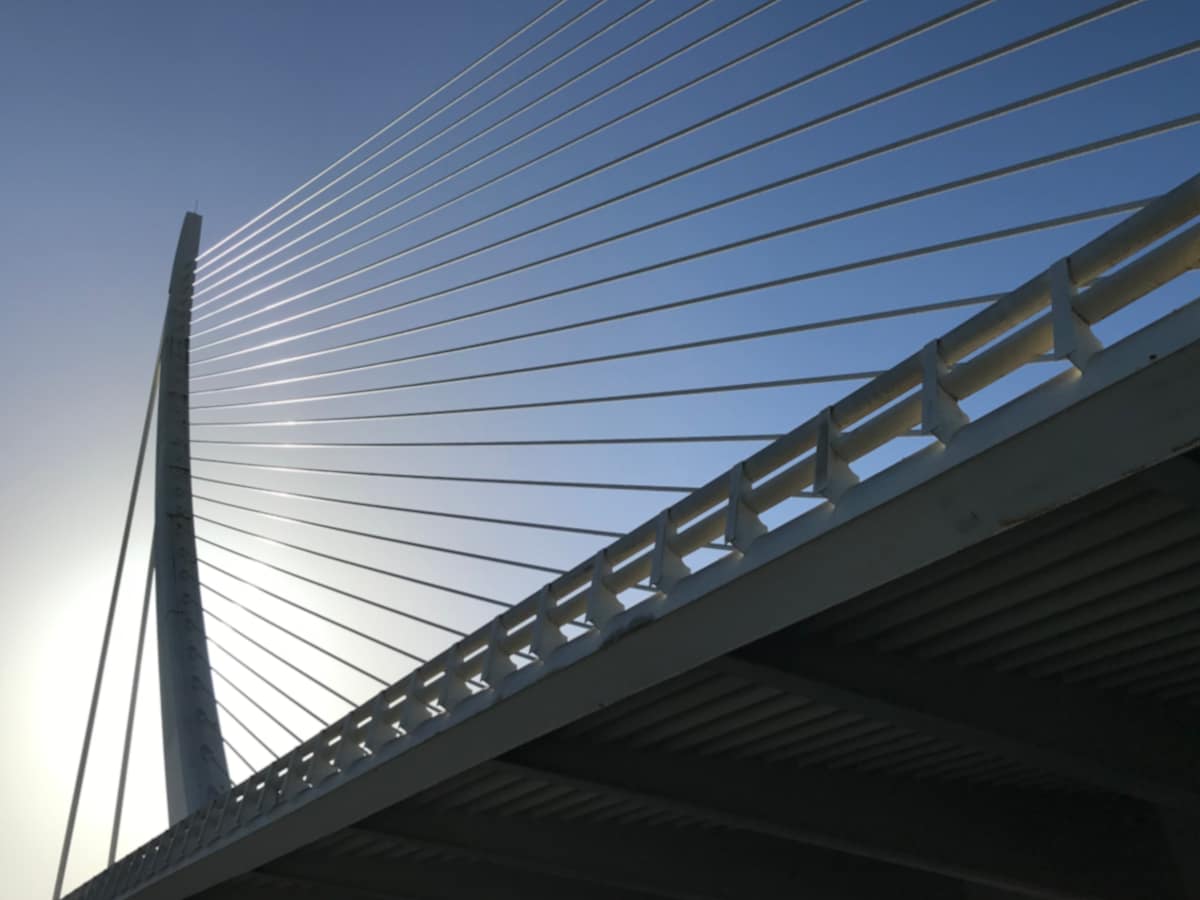
The Puente de l’Assut de l’Or bridge in Valencia, Spain, is also known colloquially by the locals as “el jamonero” due to its similarity to the device that holds legs of ham for carving. It was designed by Santiago Calatrava, who created Calgary’s “Peace Bridge” (shown earllier). Source: Wikipedia
The San Antón Bridge is the oldest bridge in Bilbao, Biscay, Spain. Source: Wikipedia
Stari Most (Old Bridge) in Mostar in Bosnia and Herzegovina. It was destroyed during the Croat–Bosniak War and later rebuilt. Source: Wikipedia
The Széchenyi Chain Bridge spans the River Danube between Buda and Pest. Source: Budapest.org
Tower Bridge’s Neo-Gothic design was chosen to blend with the Tower of London, a request by Queen Victoria. Source: TowerBridge.org.uk
The Vizcaya Bridge has two methods of crossing the River Ibaizabal. There’s a gondola on the lower part to transport vehicles and people. Or one can use the elevators to access the upper portion to walk across. Source: UNESCO
The Zubizuri Footbridge (Calatrava) in Bilbao, Spain, has glass walkways. However, these proved so treacherous when wet, such as in the rainy day pictured here, that they were covered with a non-slip mat. BilbaoTurismo
Para brindar las mejores experiencias, utilizamos tecnologías como cookies para almacenar y/o acceder a información del dispositivo. Dar su consentimiento a estas tecnologías nos permitirá procesar datos como el comportamiento de navegación o identificaciones únicas en este sitio. No dar o retirar el consentimiento puede afectar negativamente a determinadas características y funciones.
Funcional
Siempre activo
El almacenamiento o acceso técnico es estrictamente necesario con la finalidad legítima de posibilitar la utilización de un servicio específico solicitado explícitamente por el suscriptor o usuario, o con la única finalidad de realizar la transmisión de una comunicación a través de una red de comunicaciones electrónicas.
Preferencias
El almacenamiento o acceso técnico es necesario con el fin legítimo de almacenar preferencias que no son solicitadas por el suscriptor o usuario.
Estadísticas
El almacenamiento o acceso técnico que se utilice exclusivamente con fines estadísticos.El almacenamiento o acceso técnico que se utilice exclusivamente con fines estadísticos anónimos. Sin una citación, un cumplimiento voluntario por parte de su proveedor de servicios de Internet o registros adicionales de un tercero, la información almacenada o recuperada únicamente con este fin generalmente no puede usarse para identificarlo.
Marketing
El almacenamiento o acceso técnico es necesario para crear perfiles de usuario para enviar publicidad o para rastrear al usuario en un sitio web o en varios sitios web con fines de marketing similares.
Deja un comentario
