


With spring approaching, the blooms are out on the almond and olive trees in the Valencia region
This flowery harbinger also marks the beginning of the tax season. And just as irritating, the allergy season, but that’s a story for another day…
There is the old cliché about death and taxes: Two things that one can always expect. I’m not dead yet, so it’s taxes. Specifically tax liability in Spain. As a tax resident, you live more than 183 days in a year in Spain. Therefore, you are obligated to file a wealth and income tax form here.
If you are a United States citizen, then you must file a domestic return. This is required regardless of where you live. The U.S., you see, is one of only two nations, Eritrea being the other one, that tax their citizens globally.

The following is not tax advice – merely a recounting of a personal experience
Taxes, and especially, international income, can get you mired deep in the weeds. So, consult a professional tax advisor to navigate your personal situation. Actually, I used a tax advisor for my first returns here. This provided me with a template to report the various items for the Spanish tax forms.
The big assessment is the personal income tax. Known in Spanish as the Impuesto sobre la Renta de las Personas Físicas, or more familiarly the IRPF. This is the one most of us are most acquainted with. The filing is due by the end of June.
Spain also has a “Wealth Tax” (impuesto de patrimonio). That is the value of all assets: financial accounts, investments, and real estate holdings. “Wealth” is a misnomer. Basically it’s the total value of assets. The amount you report is then subject to a progressive tax. Spanish regions have varying thresholds at where you are expected to pay the tax and how much.
There’s also the “Solidarity Tax” (Impuesto de Solidaridad). It ensures everyone pays at least something, even if the comunidad doesn’t have a wealth tax. Anyway, that’s the way it’s supposed to work.
Keep your eye on the ball, and that one, and that one, too
With that out of the way, here’s how it works in practice.
A quick glossary of terms:
- Modelo 720: It’s the informational filing to tell the taxing authority of what you own.
- Modelo 714: It’s the actual filing you make to find out what you owe on what you own.
- IRPF: It’s the income tax due on what you earned during the tax year.
- IRS 1040: This is the main form filed by U.S. taxpayers, which can include all sorts of attached forms.
OK, dear reader, your head is spinning by now. But wait, it gets better.
The Modelo 720 is due by 31 March. The Modelo 714 is due between the beginning of April and the end of June. The IRPF is due by 30 June, with the first payment due soon after. In between that is the U.S. filing to the IRS, which is traditionally due on 15 April (depending on holidays or a weekend).

Got that? Keep all the balls in the air
At the beginning of the year, one files the Modelo 720. After that, it’s suggested to do a preliminary 1040. This helps to see what is owed to the IRS. Then, file an extension to October. Around 1 April the site to file the Modelo 714 opens for the tax year. File that and note the tax amount (if any, it depends where you reside in Spain).
Next, it’s the IRPF using the numbers used for the IRS 1040. After determining the Spanish tax liability, apply those numbers to the 1040. This offsets any stateside taxes (the double taxation thing). It’s like a whole other ballgame – even in Spanish. Don’t forget to make the conversion from your home currency to the Euro’s value at the end of tax year.
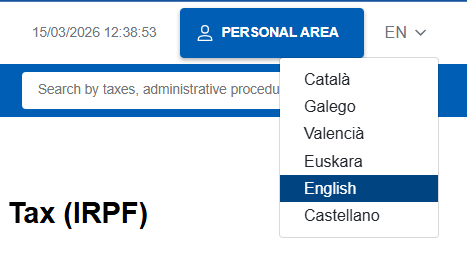
With the exception of the 1040 form, all the above is done in Spanish. Well, you can get a Spanish translation of the 1040 if you want. The help guides from Spain’s Agencia Tributaria are translated into English and other languages. However, the actual filing fields remain in Spanish, Catalan, Valencian, Galician, or Basque.
Using tax professionals is recommended at the onset. Even if you are comfortable with filing U.S. taxes, for Spain it’s a whole other ballgame. Sort of like the difference between U.S. football and European football. It sounds the same. There are a similar number of players on the field per side. But that is about it. The competition is that both teams (or countries) want to maximize their winnings (taxes).


The upside of death?
If you die at any point in the tax year, you usually are not expected to pay the wealth tax. That is the death part. Lucky you.

Want to know more about what’s due and when? Here’s the tax calendar for the year 2026 in Spain.

This is not to dissuade anyone from moving abroad – or to Spain in particular. Just know that there’s more to the decision than just finding a place to live. Taxes are part of life. And when they are not, that’s the other thing.



Leave a Reply